
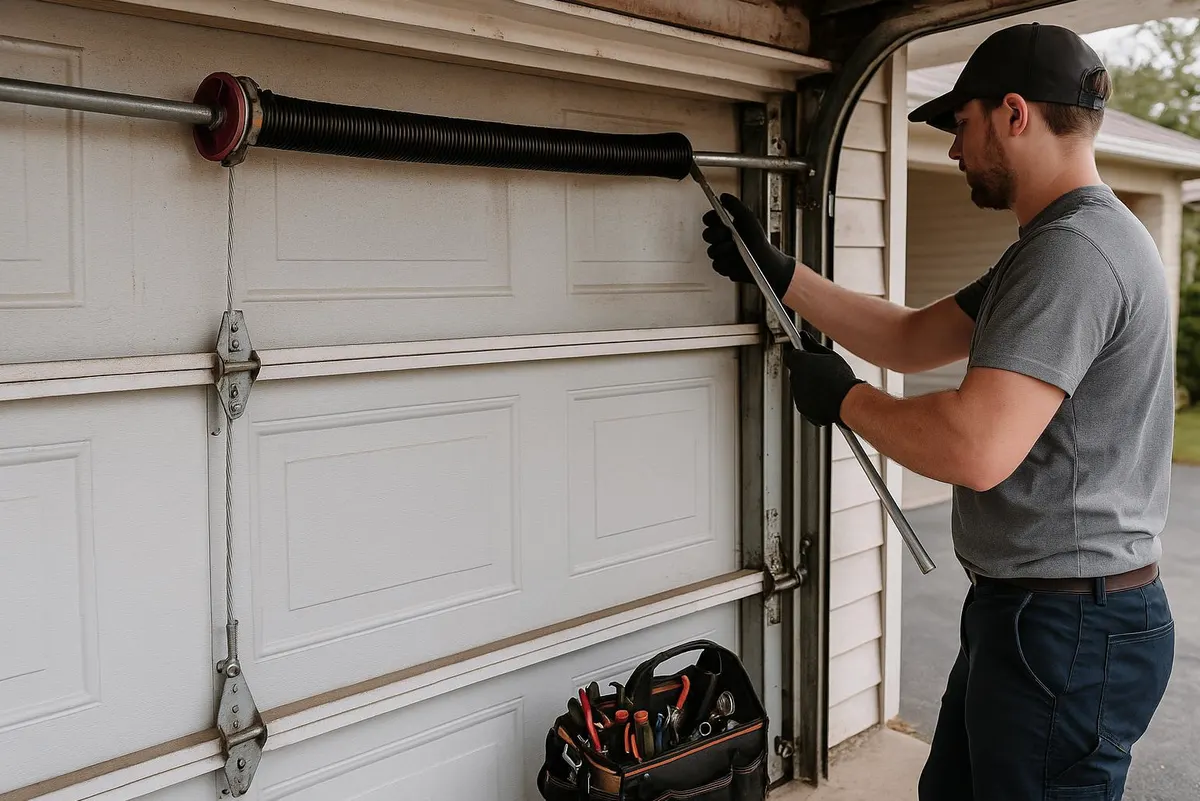
When a garage door starts down and then jerks back up, or just refuses to close, the first thing most homeowners try is grabbing a screwdriver and cranking the "close force" adjustment on the opener. It's tempting because it's a visible dial, it feels like the obvious fix for a door that "isn't trying hard enough," and sometimes it even works on the next attempt. But that adjustment controls a safety feature, not a nuisance setting. The opener's auto-reverse system exists to stop the door before it closes on something — a pet, a trash can, a kid's bike, a foot. Turning up the force doesn't fix whatever is making the door hesitate; it just overrides a safety check that was doing its job. The better move is figuring out why the door is struggling in the first place.
What Your Garage Door Is Telling You
- Door closes partway, stops at the same spot every time, then reverses — a consistent location points to a sensor or obstruction issue rather than a random mechanical fault.
- Door reverses at different points, or only after temperatures drop — suggests mechanical binding that worsens in cold weather.
- Door won't move at all; motor hums or does nothing — points to power, limit, or spring problems rather than the reversal system.
- Opener light blinks a set number of times — many openers use blink codes to identify which safety circuit tripped; check the manual before assuming the worst.
Working Through the Causes, in the Order a Technician Checks Them
1. Safety Sensor Misalignment or Obstruction
The two small "eyes" sit 4–6 inches off the ground on either side of the track. If they're not aimed precisely at each other, or anything breaks the beam — a cobweb, blown-in leaves, condensation, or a thin film of frost on a cold morning — the opener will refuse to close the door or reverse it partway down. Check for a steady indicator light on each sensor; blinking usually means misalignment. Wipe the lenses and gently re-aim the brackets if needed. This resolves a large share of "won't close" calls and costs nothing but a few minutes.
2. Track Obstruction or Debris
Leaves, acorns, salt residue tracked in off winter roads, or small chunks of ice can sit in the track and stop the door's travel. With power off, run a hand along the track and clear anything visible.
3. Bent or Misaligned Track
Much of the housing stock in this area has original track that's shifted slightly over decades of settling, or taken a hit from a car bumper or snow shovel. A track even slightly out of parallel can cause the door to bind partway down. A technician checks this with a level and straightedge, then re-aligns or replaces the damaged section.
4. Opener Limit Settings
Every opener is programmed to know exactly where "fully closed" is. A power outage, a battery backup cycling during a nor'easter, or simple drift over time can throw this off, causing the door to stop short and reverse, or never register as closed at all. Resetting the travel limits is a quick in-panel adjustment.
5. Force Settings vs. Actual Resistance
If the door is harder to move than it should be — stiff hinges, thickened grease, a slightly bent panel — the opener may read that resistance as an obstruction and reverse automatically. This is exactly why cranking the force dial first is backwards: it masks the stiff hardware instead of fixing it.
6. Worn Rollers and Hinges
Humid summers followed by freeze-thaw winters are hard on hardware. Rollers and hinges that were fine all summer can start binding once temperatures drop and old lubricant thickens, or once road salt has had a season to work on exposed metal. That added friction reads to the opener as resistance it needs to stop for.
7. Weak or Broken Torsion Spring
If the door won't close at all, hesitates heavily, or the opener motor strains audibly, the spring may be failing. Springs lose tension gradually, and big daily temperature swings can speed that up. A door too heavy for a tired spring makes the opener work overtime, trip its own limits, or stall outright. Torsion springs are under high tension and this isn't a DIY repair.
8. Cables and Drums
Less common, but worth a final check: a frayed cable or one that's slipped off its drum causes uneven travel and sudden reversals.
When to Call Pottstown Garage Door
If you've wiped the sensors, cleared the track, and the door still won't close reliably — or it won't close at all — it's time to call. We'll diagnose the actual cause rather than just adjusting the force dial, and if it turns out to be a weak or snapped spring, our Garage Door Spring Replacement service handles that safely with the right tools and tension equipment. If your door is stuck open overnight before a storm rolls through, our Emergency Garage Door Service gets a technician out to secure it. Don't wait on a door that won't close all the way — it's a security gap and a sign something in the system is already struggling.
Call Pottstown Garage Door today to get your garage door closing — and staying closed — the way it should.